This is an official TSA announcment. Will the person whose pants are falling down please return to the Security area in Concourse C to retrieve his or her belt.
Nonprofit management, nonprofit technology, local interest, travel, community stuff, political stuff. Basically, anything I feel like sending out to the blog world.

This is an official TSA announcment. Will the person whose pants are falling down please return to the Security area in Concourse C to retrieve his or her belt.
- Stop thinking you know everything
- Stop mistaking marketing for overhead--and stop hating overhead"
- Stop funding redundancy
- Stop thinking that newer is better.
Short summary:
Miscellaneous thoughts on trip:
Our last day at sea:
The executive director and two staff from Oceanities were on the ship for the whole voyage. Oceanities is a nonprofit organization that is conducting a multi-year biological site inventories at a variety of critical environmental sites around the Antarctica Peninsula. Oceanities is a small, independent research organization funded by foundations, individual contributions and the National Science Foundation. They are the only non-governmental research organization operating in Antarctica. More information about Oceanities is at their website at http://www.oceanites.org.
It’s been great having the Oceanities researchers onboard. Ron, the executive director gave one talk on their research that was very interesting. But more important, when they are not counting penguins and doing photo documentation of sites, they act as additional naturalists--very knowledgeable naturalists. (Lindblad/National Geographic provides logistics support by allowing the Oceanities researchers to use their cruises to access the sites.)
Some major points from Ron’s talk:
One plentiful bird was the a local thrush that looks had behaves exactly like the North American robin (at least a faded robin--no red breast). It is in fact very closely related.
That afternoon, we visit New Island, the western most of the Falkland Islands. Again, a privately owned island, much of it was used for grazing sheep--the tussuc grass has been replaced by a European grazing grass.
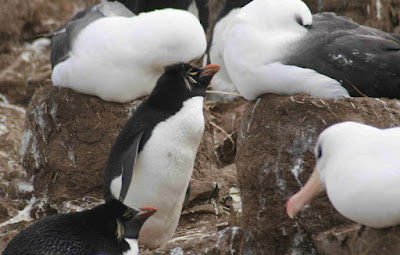
We land in a sheltered natural harbor and then hike across a narrow point to the northwestern side. On the hike, we see numerous kelp and upland geese. They have thrived since the sheep were removed--the love the grassy areas. The area we hiked to had been fenced off while sheep were here (to keep them from falling off a high cliff into the ocean.so there is still plenty of tussuc grass. The area below the clifts and along the edge are filled with nesting black browed albatross, Blue-eyed shags (a cormorant) and rock-hopper penguins. We hang out there for over two hours. Lots of “pixels are burned.”
The rock-hopper penguins are the smallest penguin--only about 16 inches tall and are related to the macaroni penguin. They seem to be able to hop up about 12 inches and down about 18 inches. It is amazing watching them move around. They are the first penguin we see that makes a more traditional nest--out of mud, grass and guano.
The albatross makes a rather high pedestal nest out of mud, grass and guano. There seem to be the clumsiest birds when landing--most times falling over in the process. To take off, they walk to the edge of the cliff, wait for a gust of wind and jump.
The blue-eyed cormorants have amazing blue eyes a beautiful blue-black feathers and bright orange tufts of feathers around their beak.
The Lindblad staff managed to make the last day on-shore a great climax.
This morning we’re at Steeple Jason Island. It is one of the chain of Jason chain of islands stretching 40 miles northeast of the main Falkland Islands. It is owned by a nonprofit that is starting to restore it. It is usually not included in cruises--even by Lindblad because of the difficult landing conditions. However, today the wind is right for a reasonable landing. We hike about two kilometers up a ridge. When we get over the ridge, we are treated to the world’s largest black-browed albatross colony, containing about 157,000 breading pairs (over 300,000 birds). The colony is over three miles long along the rocky beach. The number in the air is amazing. A few of us make our way through the tussuc grass mounds down to the edge of the colony. We end up right under the flight path of the albatross.
Nesting among the albatross are rock-hopper penguins. These are the smallest of the penguins we’ve seen. The lichens are amazing--orange, brown, red, green. Some really cool green lichen that forms ribbons.
At lunch we are at the same table as Melissa--one of the people from Oceanities. Her real job is working for Rathyon’s Antarctic Services division. They have the contract with the National Science Foundation to provide all the logistical support and manage the three US research stations on Antarctica as well as the two research ships. Melissa’s job there is project manager for research projects that work away from the three bases in tent camps. She takes vacation and leave to work with Oceanities in Antarctica. She gave us a feeling for the complexity of getting materials to the Antarctic bases for research.
That afternoon we land at Saunder’s Island. Landing was easy but as we walk toward the rock-hopper colony the wind picks up. Sand is blowing across the beach. I’d guess it was about 40 miles per hour. Then it gets cloudy and we’re in a driving sleet. The sleet lasts only about 10 minutes and the sun comes out. Wind is still strong but the sleet at least stopped the sand from blowing. Just another case of the weather changing very quickly and very often in the Falklands.
The weather changes by the minute here. Sleet followed by sunny skies, followed by stiff winds followed by calm, followed by a driving downpour, followed by sunny skies (in a period of four hours.
After the tour, we do some gift shopping in downtown Stanley with some on foot sight seeing. We end by going into the Global Tavern Pub. It appears half the ship also decided to stop at this pub.
As soon as we get onboard, we head off to tomorrow’s landing--in the far northwest of the Falkland Islands.
It turns out that all of Lindblad’s trips to Antarctica include photography experts who are there to help the guests. It has been great asking both Flip Nicklin (the National Geographic photographer on board) and Ralf Hopkins (the Lindblad staff photographer on our trip) for advice and help. Besides the one-on-one help they provide, Ralph did a session in the lounge on Ten Tips to Improve Your Images. Here are some tips I really liked:
(From Ralph Lee Hopkins, RalphLeeHopkins.com)
At 1 AM a passenger is transferred aboard from another company’s cruise ship. He had broken his hip and we will be the fastest way to get him to a hospital in the Falklands (since that is our next stop). Our doctor does an evaluation and we end up leaving immediately for the Falklands to get him to the hospital as soon as possible (we had planed on one more stop on South Georgia this morning). According to the expedition leader, they have platted a course to avoid the worse weather--going between two weather systems.
We head to the northwest end of South Georgia and take a course west-south-west. We have a 40 knot (45 MPH) wind on our starboard with hugh ocean swells. I put on a sea-sickness transdermal patch at about 4 AM. Bev and I skip breakfast and sleep in--it is great to be able to sleep in and not miss anything.
Because of the rough seas--ten to twelve foot swells--we don’t have the typical buffet for lunch. The wait staff brings us our food.
Staff organizes an Antarctic/South Georgia Jeopardy game. We both pass
Thursday is more rough sees. I don’t feel bad about having to wear the sea-sickness patch--staff members are getting sea sick.
South Georgia government prohibits approaching closer than 200 meters (2 football fields) to the old whaling station because the strong winds can pick off pieces of sheet metal from the old buildings and send them flying. (It seems to be an example of a little overly cautious British Government.) We get fairly close to the old station by zodiac. It has been taken over by fur and elephant seeds and sea birds. We then land and hike back from the beach for more nature. We have to land on a beach with lots of breeding fur seals. The keep the tourists in line and the fur seals in their place, they have set kayaks up to provide a corridor up the beach to an area where the fur seals are less numerous.
During lunch we head to Grytviken--again on the open sea during lunch but today isn’t as bad as Monday. The Norwegians started whaling at Grytviken in 1904 and it changed ownership a number of times--ending with a two year lease to a Japanese company that was trying to develop a market for frozen whale meat. They were not successful because most of the whales had already been killed. This is also where Sir Ernest Shackleton died of a massive heat attack at the start of an expedition he launched in the 1920s. He is grave is here and we visit it and toast him with a shot of rum. Steve (the naturalist who also specializes in history) gives Shackleton a great tribute. The passenger who is the trumpet player played Bramhs (spelling?) Lullaby at gravesite. I thought that was a strange choice but we learn at the wrap-up that it is the same song that was played on banjo by one of Shackleton’s crew at Shackleton’s funeral. There are a number of people on this trip who came specifically because they are Shackleton history buffs so this is a very significant stop for them.
The museum here includes a lot of information on Shackleton (including a recreation of the 23 foot lifeboat he used to sail sail the 800 miles from Elephant Island to here), information on whaling history and natural history. It also includes history of the Falkland war (Argentina invaded South Georgia and occupied the research station, government offices and old whaling station for about two weeks.) It is a really good small museum in the middle of nowhere. Much of this whaling station has
been torn down for safety but we are allowed to walk around the remaining buildings (which have been stabilized). Whaling ended here in 1965.
In the last few years of whaling they seem to have made use of much of the animal (not just the blubber for oil). Some of the pictures are pretty gruesome. It turns out that if you ate margarine in the 1950s or early 1960s, you were eating hydrogenated whale oil.
Evening wrap-up: Some great stories about the Shackleton expedition but the highlight is a presentation by the staff from the South Georgia government and the British Antarctic Research facility. Some interesting random facts: