This is an official TSA announcment. Will the person whose pants are falling down please return to the Security area in Concourse C to retrieve his or her belt.
Nonprofit management, nonprofit technology, local interest, travel, community stuff, political stuff. Basically, anything I feel like sending out to the blog world.

This is an official TSA announcment. Will the person whose pants are falling down please return to the Security area in Concourse C to retrieve his or her belt.
Short summary:
Miscellaneous thoughts on trip:
Our last day at sea:
The executive director and two staff from Oceanities were on the ship for the whole voyage. Oceanities is a nonprofit organization that is conducting a multi-year biological site inventories at a variety of critical environmental sites around the Antarctica Peninsula. Oceanities is a small, independent research organization funded by foundations, individual contributions and the National Science Foundation. They are the only non-governmental research organization operating in Antarctica. More information about Oceanities is at their website at http://www.oceanites.org.
It’s been great having the Oceanities researchers onboard. Ron, the executive director gave one talk on their research that was very interesting. But more important, when they are not counting penguins and doing photo documentation of sites, they act as additional naturalists--very knowledgeable naturalists. (Lindblad/National Geographic provides logistics support by allowing the Oceanities researchers to use their cruises to access the sites.)
Some major points from Ron’s talk:
One plentiful bird was the a local thrush that looks had behaves exactly like the North American robin (at least a faded robin--no red breast). It is in fact very closely related.
That afternoon, we visit New Island, the western most of the Falkland Islands. Again, a privately owned island, much of it was used for grazing sheep--the tussuc grass has been replaced by a European grazing grass.
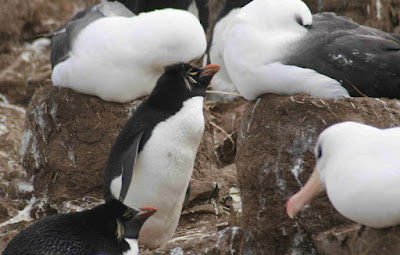
We land in a sheltered natural harbor and then hike across a narrow point to the northwestern side. On the hike, we see numerous kelp and upland geese. They have thrived since the sheep were removed--the love the grassy areas. The area we hiked to had been fenced off while sheep were here (to keep them from falling off a high cliff into the ocean.so there is still plenty of tussuc grass. The area below the clifts and along the edge are filled with nesting black browed albatross, Blue-eyed shags (a cormorant) and rock-hopper penguins. We hang out there for over two hours. Lots of “pixels are burned.”
The rock-hopper penguins are the smallest penguin--only about 16 inches tall and are related to the macaroni penguin. They seem to be able to hop up about 12 inches and down about 18 inches. It is amazing watching them move around. They are the first penguin we see that makes a more traditional nest--out of mud, grass and guano.
The albatross makes a rather high pedestal nest out of mud, grass and guano. There seem to be the clumsiest birds when landing--most times falling over in the process. To take off, they walk to the edge of the cliff, wait for a gust of wind and jump.
The blue-eyed cormorants have amazing blue eyes a beautiful blue-black feathers and bright orange tufts of feathers around their beak.
The Lindblad staff managed to make the last day on-shore a great climax.
This morning we’re at Steeple Jason Island. It is one of the chain of Jason chain of islands stretching 40 miles northeast of the main Falkland Islands. It is owned by a nonprofit that is starting to restore it. It is usually not included in cruises--even by Lindblad because of the difficult landing conditions. However, today the wind is right for a reasonable landing. We hike about two kilometers up a ridge. When we get over the ridge, we are treated to the world’s largest black-browed albatross colony, containing about 157,000 breading pairs (over 300,000 birds). The colony is over three miles long along the rocky beach. The number in the air is amazing. A few of us make our way through the tussuc grass mounds down to the edge of the colony. We end up right under the flight path of the albatross.
Nesting among the albatross are rock-hopper penguins. These are the smallest of the penguins we’ve seen. The lichens are amazing--orange, brown, red, green. Some really cool green lichen that forms ribbons.
At lunch we are at the same table as Melissa--one of the people from Oceanities. Her real job is working for Rathyon’s Antarctic Services division. They have the contract with the National Science Foundation to provide all the logistical support and manage the three US research stations on Antarctica as well as the two research ships. Melissa’s job there is project manager for research projects that work away from the three bases in tent camps. She takes vacation and leave to work with Oceanities in Antarctica. She gave us a feeling for the complexity of getting materials to the Antarctic bases for research.
That afternoon we land at Saunder’s Island. Landing was easy but as we walk toward the rock-hopper colony the wind picks up. Sand is blowing across the beach. I’d guess it was about 40 miles per hour. Then it gets cloudy and we’re in a driving sleet. The sleet lasts only about 10 minutes and the sun comes out. Wind is still strong but the sleet at least stopped the sand from blowing. Just another case of the weather changing very quickly and very often in the Falklands.
The weather changes by the minute here. Sleet followed by sunny skies, followed by stiff winds followed by calm, followed by a driving downpour, followed by sunny skies (in a period of four hours.
After the tour, we do some gift shopping in downtown Stanley with some on foot sight seeing. We end by going into the Global Tavern Pub. It appears half the ship also decided to stop at this pub.
As soon as we get onboard, we head off to tomorrow’s landing--in the far northwest of the Falkland Islands.
It turns out that all of Lindblad’s trips to Antarctica include photography experts who are there to help the guests. It has been great asking both Flip Nicklin (the National Geographic photographer on board) and Ralf Hopkins (the Lindblad staff photographer on our trip) for advice and help. Besides the one-on-one help they provide, Ralph did a session in the lounge on Ten Tips to Improve Your Images. Here are some tips I really liked:
(From Ralph Lee Hopkins, RalphLeeHopkins.com)
At 1 AM a passenger is transferred aboard from another company’s cruise ship. He had broken his hip and we will be the fastest way to get him to a hospital in the Falklands (since that is our next stop). Our doctor does an evaluation and we end up leaving immediately for the Falklands to get him to the hospital as soon as possible (we had planed on one more stop on South Georgia this morning). According to the expedition leader, they have platted a course to avoid the worse weather--going between two weather systems.
We head to the northwest end of South Georgia and take a course west-south-west. We have a 40 knot (45 MPH) wind on our starboard with hugh ocean swells. I put on a sea-sickness transdermal patch at about 4 AM. Bev and I skip breakfast and sleep in--it is great to be able to sleep in and not miss anything.
Because of the rough seas--ten to twelve foot swells--we don’t have the typical buffet for lunch. The wait staff brings us our food.
Staff organizes an Antarctic/South Georgia Jeopardy game. We both pass
Thursday is more rough sees. I don’t feel bad about having to wear the sea-sickness patch--staff members are getting sea sick.
South Georgia government prohibits approaching closer than 200 meters (2 football fields) to the old whaling station because the strong winds can pick off pieces of sheet metal from the old buildings and send them flying. (It seems to be an example of a little overly cautious British Government.) We get fairly close to the old station by zodiac. It has been taken over by fur and elephant seeds and sea birds. We then land and hike back from the beach for more nature. We have to land on a beach with lots of breeding fur seals. The keep the tourists in line and the fur seals in their place, they have set kayaks up to provide a corridor up the beach to an area where the fur seals are less numerous.
During lunch we head to Grytviken--again on the open sea during lunch but today isn’t as bad as Monday. The Norwegians started whaling at Grytviken in 1904 and it changed ownership a number of times--ending with a two year lease to a Japanese company that was trying to develop a market for frozen whale meat. They were not successful because most of the whales had already been killed. This is also where Sir Ernest Shackleton died of a massive heat attack at the start of an expedition he launched in the 1920s. He is grave is here and we visit it and toast him with a shot of rum. Steve (the naturalist who also specializes in history) gives Shackleton a great tribute. The passenger who is the trumpet player played Bramhs (spelling?) Lullaby at gravesite. I thought that was a strange choice but we learn at the wrap-up that it is the same song that was played on banjo by one of Shackleton’s crew at Shackleton’s funeral. There are a number of people on this trip who came specifically because they are Shackleton history buffs so this is a very significant stop for them.
The museum here includes a lot of information on Shackleton (including a recreation of the 23 foot lifeboat he used to sail sail the 800 miles from Elephant Island to here), information on whaling history and natural history. It also includes history of the Falkland war (Argentina invaded South Georgia and occupied the research station, government offices and old whaling station for about two weeks.) It is a really good small museum in the middle of nowhere. Much of this whaling station has
been torn down for safety but we are allowed to walk around the remaining buildings (which have been stabilized). Whaling ended here in 1965.
In the last few years of whaling they seem to have made use of much of the animal (not just the blubber for oil). Some of the pictures are pretty gruesome. It turns out that if you ate margarine in the 1950s or early 1960s, you were eating hydrogenated whale oil.
Evening wrap-up: Some great stories about the Shackleton expedition but the highlight is a presentation by the staff from the South Georgia government and the British Antarctic Research facility. Some interesting random facts:
We do land on a different beach in Cooper Bay and find a dead elephant seal being pecked at by skuas and giant petrals. The giant petrals really have the vulture niche in South Georgia. They even have same behaviors--charging with out stretched wings, tail in a vertical posture, getting their whole head into the carcass.
One of the king penguin chicks seems to be desperate for food. Keeps going up to anything (including people and tripods) begging for food. We take a hike up a snow field looking for albatross nests. No nests but a great walk.
The afternoon is a zodiac cruise up the very narrow Larson Harbor. This is a scenery excursion, not wildlife. It was amazing. Later, the ship cruises up Drygalski Fjord to the tidewater glacier at its head. To leave, the captain uses the bow and stern thrusters to pivot the ship.
In the wrap-up before dinner under-water videos from the ROV--some cool, strange things live on the floor of the ocean here. Also a song by one naturalist about krill--”All you need is krill.” (think Beatles)
Our first stop is at Gold Harbor on South Georgia. Staff had offered a landing before sunrise at 5:00AM (for the photographers who are looking for that “magic light”) but it was cloudy and raining. Rain stopped and we were on the beach by nine. Elephant seals, fur seals and king penguins. Lots of king penguins. The noise from the adults and the chicks were amazing. There were the creches of brown fluffy chicks making songbird like calls--waiting for mom or dad to come back and regurgitate a meal. The sailors who first saw them referred to them as “the okum boys” because they looked like the rope and tar caulk called okum that was used to fill cracks in ships. They look like a sea of brown with a black and white and orange adult scattered among them. I think I shout 400 pictures before I just put the camera away and just watched. The penguins (adults and chicks will walk to about two feet from you. If you sit down by a wiener seal (the young elephant seals) it is not unlikely they will come over and try to nurse you boot or your knee.
“The Government of South Georgia” is serious about enforcing the regulations for tourists. This site is has video surveillance from a number of points of view to insure tour groups stay out of restricted areas (sensitive animal habitats)
Much of the land beyond the beach is covered by tussoc grass. It is a challenge to walk through. Bev did and climbed a ridge to see a albatross nest with chicks. (She still needed binoculars).
Oceanites doesn’t count king penguins (not in their study plan) but Ron notes that they would be very hard to count. While the brush tail penguins (chinstrap, Adelie and gentoo penguins) all mate at the same time and the chicks leave the nest before winter, kings are on a 18 month breading cycle. Many times you will find single molting penguins, chicks, and pairs incubating an egg, all at the same colony.
In the afternoon we head to St. Andrews Bay. Elephant seals, fur seals, king penguins and reindeer. No tussoc grass at this location (the reindeer graze to the ground. We head off to the south following a naturalist. Go up a ridge and look down on the largest colony we’ve seen. Over 400,000 king penguins. The largest colony of kings on South Georgia. We have now seen over one million penguins.
While I’m writing this in the ship library, I’m watching four snowy-sheath-bills out the window. White birds about the size of a pigeon, a face sort of like a chicken and at first glance appear rather dumb and clumsy. But they are checking everything out. Pulling on wires, pecking at latches, tugging at straps (all on top of the enclosed life boats). They also are very coordinated--just saw one land while going backwards.
snowy sheath bill.
After breakfast we all attend a required briefing on South Georgia. South Georgia is part of the United Kingdom and administered from government offices in the Falklands. We see a video by “The Government of South Georgia” (that seams kind of a strange term since the only people who live here are the staff of two small U.K. research stations). The basic message is “we are really serious about not bringing in any more exotic plants or animals and we are really serious about protecting the wildlife.” It also has some safety warnings, like “stay away from fur seals!” (punctuated by a picture of a person’s hand after being bitten--you can see pieces of finger bones.) Exotic species currently on South Georgia include a beetle, reindeer (introduced by the whaling industry to provide fresh meat), dandelions, and the Norway rat. Since the birds on South Georgia evolved with no land predator, they have started to eradicate the Norway rat.
After seeing the video, we are all required to go through bio-sanitizing. This includes have all our outerwear inspected--and camera bags and pockets vacuumed out. They pay particular attention to checking for seeds stuck in Velcro. (This is our second bio sanitizing--our first was before we set foot on any antarctic island.) As with Antarctica, we step in a disinfectant before leaving the ship and when returning from the ship.
To kill the time, another naturalist talk--an introduction to South Georgia. Did you know the South Georgia Pintail is a vampire duck? It will eat the blood from the wounds on seals.
Our first stop on South Georgia is the caves at the inlet to King Haakon Bay where Shackleton first landed when they reached South Georgia. We then head into the bay and take the zodiacs ashore at Peggotty Bluff--the final stop for Shackleton’s long boat and where he and two crew headed across the island (over a mountain range and glaciers) to find help at a whaling station on the other side.
Onshore the first thing you notice is that there are green plants (besides algae and lichen). The second thing is elephant seals. The pups that have just been weaned (“weaners”) are really cute with hugh black eyes. The adults are really ugly. We walk up a stream of glacier melt water. There is an alluvial plane of the rock powder created by the glacier as it slides down the mountain. It looks like a small version of the alluvial planes you see in the Japer park area in Canada. There are a couple giant giant petrels(birds) fighting over the remains of a dead seal--petrels fill the vulture niche at South Georgia.
There are about a dozen king penguins molting by the beech. The first king penguins we’ve seen.
Back on the ship, “the photography department” (Ron and Flip) have invited anyone with a laptop to create a three minute slide show sampling what they’ve shot so far. Some really impressive photography. Some really cool ideas I’m going to steal. We just didn’t seem to have the time to put a slide show together.
Oceanites also announces the winner of “how may penguins have we seen so far” contest. The winner was only 32,000 penguins off. So far, we have seen over 402,000 penguins (I was way off--I guessed 15,000)
We are at sea all day today, headed for South Georgia Island--on the open ocean. More naturalist/staff talks to keep us out of trouble.
The first talk of the day was about the Shackleton Expedition in the early 1900s. More talk about ships getting caught in ice, ships being crushed by ice. Shackleton had taken the long-boats from his ship, his crew pulled them across the surface ice, launched them and got to Elephant Island. This is the island we spent much of yesterday trying to get through the pack ice to see.
The second talk was about plate tectonics. The talk started by noting that a 17th century Anglican bishop had calculated the exact date God created the earth--on a Saturday, 4004 BC, at sunset. (A couple sarcastic notes--would god work on the Jewish Sabbath? at sunset where? He calculated it using the bible and “other sources.” That the extreme fundamentalists pin their belief of a “young earth” on a calculation made in the 17th century Anglican bishop is beyond me. (The talk then explained plate tectonics and how Antarctica ended up at the southern pole and why it has been stuck there.)
Next talk is 10 tips for improving travel photography with Rolf Hopkins (the Lindblad staff photographer on board). If I get around to it, I’ll write a post specifically about his talk. As a teaser, two bonus tips are:
“If you want to take better photos, stand in front of better stuff.”
“Find the best light and shoot what’s in it.”
Happy Thanksgiving Day in the U.S. Dinner options included a traditional turkey dinner. I had the grilled salmon.
We were woken up be things falling off shelves. The sea is getting rougher.
We’re trying to get to Elephant Island--where Shackleton’s crew overwintered The island is surrounded by pack ice. Spent the morning moving around trying to find an opening in the ice, through the fog.
We came up on two humpback whales, followed them for a while. After the captain turned back to finding a way through the ice, the whales stayed with us for about 20 minutes more. The sonar indicates a concentration of just below the surface. The whales were eating without have to go deep
Just announced--the pack ice is too extensive. It is a mix of surface ice (OK kind of ice) glacier ice (you really don’t want to hit with a ship), multi year ice (also a no-no). We can not find a way in that would also guarantee us a way out. So we are abandoning our attempt to get to Elephant Island.
On our way to the South Orkneys, the bridge spots five fin whales-the second largest of the baleen whales. Spend about half an hour watching them, the are doing very shallow dives.
Tonight, the first showing of a new Lindblad movie, “Counting Penguins.” It is about Oceanites, the only non-governmental research group working in Antarctica. More about Oceanities in a future post.
Late update. We are skipping the South Orkneys--today’s ice report shows even more ice around the South Orkneys than around Elephant Island. So we will get an extra day on South Georgia. You have to be flexible when on a Lindblad trip. They take advantages of changing conditions with quite a few changes in plans.
Another chance to walk on sea ice. I decide--big deal, walking on ice. It turns out there were seals on the ice and it was warm. Oh well, i got spent a relaxing morning on-board.
The other activity this morning was another polar plunge. Since the law that requires Minnesotans to play “hardy Minnesotan” anytime they are out of state only requires one polar plunge per trip, I again stay on board. Turns out is was much warmer and much more pleasant that the first one. But it was still a polar plunge!
After crashing into the ice again for a marketing shot (we left the photographer on the ice), we head north, destination Elephant Island sometime tomorrow.
We cruise by an emperor penguin siting on broken sea ice with five Adelie penguins. The ship
does a U-turn and slowly creeps up on the penguins. Most of the passengers put on parkas and head for the bow--in a stiff wind driven snow. Didn’t get too close, and the emperor never stood up. It is clearly much bigger than the Adelie penguinsThe ship backs away and turns back on coarse.
We have three talks by staff in late morning and afternoon. One about the ice and climate of Antarctica. One on the history of Antarctica discovery, starting with the ancient Greek predictions of a southern continent. [Interesting note of strange symmetry--the Arctic is an ocean surrounded by continents and the Antarctic is a content surrounded by ocean.]
The last talk is a quick history of whale photography by Flip Nicklin the National Geographic photographer who is on the cruise. Flip IS the history of whale photography.
There seems to be a preoccupation on this ship with ships being destroyed by ice. There are a number of books about the Titanic, the Lusitania and Shackleton in the library, books about the Titanic and the Lusitania and a Shackleton DVD for sale in the gift shop. During the recap tonight, naturalists tell us about how “growler” ice warned sailors of icebergs nearby and read first-hand stories of sailing ships being crushed by icebergs.
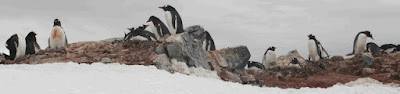
We next head to a Gentoo penguin colony on Pleneau Island. (I think I may be getting a little tired of penguins!.) I decide sit and watch the penguins hopping in and out of the water. Fascinating. Bev decides to stay a little longer and I take a zodiac back to the ship. Of course that’s when a Leopard Seal swims up and starts checking out penguins for lunch. According to Bev, the penguins immediately move away from the beach--rapidly. [Sarcastic note to Apple--how about naming the next operating system and updates after seals?]
In the afternoon we head to Port Lockroy. This was an anchorage used by explorers and whalers. In World War II, the British built a small outpost on the very small Goudier Island that was part of a secret British project to monitor German shipping movements during World War II. Seven people would overwinter here. After the war, the base was used for civilian science until 1964. It is considered a historic Antarctic site and has recently been restored by the United Kingdom Antarctic Heritage Trust as a museum and Gift Shop (They accept Pounds Sterling, US Dollars, Euros, MasterCard and VISA).
Four people staff the station during the summer tourist season. They live in rather primitive conditions--not unlike the conditions the crews when the station was operating. (Although they do get to shower on board cruise ships they are invited aboard.) They are also limited to a very small Island that also has lots of penguins--and therefore lots of penguin guano--I wouldn’t want to be hear in February after a summer of nesting penguins.
We also visit Neko Harbor for a landing after dinner. Up until now, all of our landings have been on islands in the Antarctic Peninsula archipelago (Geologically and geographically part of the continent). This landing however is on the Antarctic mainland. If we wanted to, and were equipped for it, we could walk from her to the South Pole (It would be the long way of getting there).
Back on board and there’s a pick-up jam session with the ship’s staff pianist (Victor) and a passenger who brought his Baritone trumpet on the trip.