Monday, December 08, 2008

Off the coast of Costa Rica

Saturday and Sunday, Nov 29 and 30

Saturday afternoon we boarded the ship. The ship is small enough that they use a public dock in a marina that is used by pleasure boats. Rather rough ride down to the first stop.

Manuel Antonio National Park:
Sunday morning, it's raining. The walk through the rain forest is on anyway. Why stop for a little rain? I put my camera in the supposedly waterproof backpack, get on the zodiac and were taken in for a wet landing on the beach (you hop out of the zodiac in about a foot or two of water). The rain is a downpour. The rain lasts for the full 2 hours we are on the beach and in the forest. Of course; its a RAIN forest.

Didn't take the camera out once--way too much rain. Back on the boat, I pen the pack. The top of the camera is dry--hey, it is waterproof. Pick up the camera and discover it is sitting in water. Oops, not waterproof. Turn it on, doesn't work. Take it as far apart as I can and let it dry [Update--after 24 hours, the camera still isn't working.] Update 2--It did start working the last day of the trip--after putting the camera out in the hallway of the ship (less humidity than in the cabil)]

We are in one of many national parks in Costa Rica--this one is right next to a number of resorts and is the most popular national park in Costa Rica. It is also one of the smallest. They put a limit on the number of people who can be in it at any one time so we start early. Didn't really have to--the downpour has kept everyone else away.

We did see a two toed sloth and a three toed sloth. Both just looked like brown balls of wet fur up in the trees. The guide says you can tell what kind of sloth by the kind of fur.

The plan was to head south to a river we can kayak up during high tide. But it is still a downpour and they expect the river to be too fast for safe kayaking (sea kayaks). So they check the radar and head north west to a private reserve.

Cucu Reserve:
Through some very rough water for 5 hours. I think everyone on the ship is sea sick, on Dramamine or on Dramamine and sea sick. We get to the reserve and head in on zodiacs about an hour and a half before dusk. We were rewarded. A pair of macaws and a troop of white faced monkeys. Get back to the ship in the dark.

Electronics, rainforest and air conditioning


Electronics, rain-forest and air conditioning on the ship didn't mix well.
  • On the first day in the coastal rain forest, we were in a down pour for an hour and a half. My "water proof" backpack wasn't water proof and my Canon EOS Rebel got wet. Back at the ship, it didn't work. I took the batter out and opened it up for three days to dry. Still didn't work. Hung it on the railing outside our cabin for 2 days (in the less air conditioned hallway) and it worked.
  • Bev's Canon EOS would fog up for about 45 minutes every time she went outside. Solution--hang it outside the cabin so it would stay warmer.
  • About half-way through the trip, my laptop developed the blue screen of death. Back in our very dry house in MN, it is working fine.
  • The vidiographer on the ship had to edit the DVD in the hallway because the equipment didn't work in his room.
So, why was it more humid in the cabins than the hallway?

Friday, December 05, 2008

Blue Sceen of Death in the Gulf of Panama

Wrote Friday, 12/5
No more blog updates will be uploaded until we get home--have about five done but when I fired up my laptop, I got the blue screen of death. Next attempt got stalled on the initial start-up window. So, we'll see if it is just the humidity (I'll wait until I'm in nice DRY Minnesota to try booting again). That may be a problem, people have been having trouble with digital cameras and cell phones with all the humidity.

Update: Laptop has worked fine since we got home to DRY Minnesota.

Thursday, December 04, 2008

Quakers in Monteverde

Wrote Saturday, 11/29
Last night after supper Lindblad (the tour company) arraigned for a talk from one of the Quaker founders of Monteverde. Marvin was one of the Quakers who left Alabama in the very early 1950s to settle in Costa Rica. He and his brother had refused to sign up for the draft because of the Quaker commitment to nonviolence. After serving six months in jail, they were released on probation for another six months.(Marvin is now 86) His family and a number of other families in a small Alabama town decided it was time to leave the US. The looked for a country to emigrate to and settled on Costa Rica--

  • A relatively large middle class
  • Not a lot of extremely rich or poor
  • A good economy
  • AND NO MILITARY (Costa Rica abolished their military in 1949)

While most of the families sold all their procession and flew or took a ship to Costa Rica; Marvin's family (he was 20 at the time) decided to drive a truck and a jeep to Costa Rica (his parents at the time were in their late 60s)

Marvin told a great story of never letting a roadblock stop the trip.
  • First, they discovered at the boarder of Mexico they needed an export certificate for the truck and jeep.

  • Next, they assumed the Pan-American Hi way was finished. When the reached the boarder southern boarder of Mexico, the road stopped. They loaded the truck and jeep on a narrow gauge railroad and headed to the Pacific coast where there was a road that continued south.

  • At the boarder between Nicaragua and Costa Rica, the road stopped. They drove to the port on the port on the coast. After getting there, they discovered the ships anchor off the coast and there was no way to get something as big as a truck, or even a jeep, on board.

Most of their party went by ship to Costa Rica. The three young men (early 20s) drove the jeep and truck back to the end of the Pan-American highway. They then started hacking at the forest, building a bridge, and making a corduroy road over a swamp. One month and 18 miles later, the reached a "road."

The end of the story is they bought a tract of land, divided up much of it into individual dairy farms, started a cheese factory and put the headwaters of the river into joint ownership as a preserve to protect their water supply. The cheese business now supplies dairy products to all of Costa Rica, the rest of Central America and the Caribbean. The headwaters preserve was the start of the protected zone of the Monteverde cloud forest.

Monteverde cloud forest

Thursday, 11/27, Friday, 11/28

Leaving the hotel for the rain forest at 3:30. Before we left the hotel we saw tow Black Guan (large birds related to turkeys--all black except for a green mark on the beak. Not great pictures--very dark birds in a very dark forest.

The Reserva Biologica del Bosque Nuboso de Monteverde. This is one piece of a huge cloud forest preserve made up of a number of pieces owned by different conservation groups (including the Government of Costa Rica). About an hour and a half walk through the rain forest. Constant mist. "Most of the precipitation comes from leaking clouds, not rain.".

Lots of birds. Black: Quail, house and rufous-napped wrens, scarlet tanager, and the biggest, brightest blue humming bird I've seen. Not many pictures--a cloud forest with canopy trees and constant mist at 4:00 is kind of dark (understatement). Even setting the camera to 1600 ASA speed doesn't help much.

Ended tour at a bunch of humming bird feeding stations. An unbelievable number and variety of hummingbirds. After the hummingbirds leave at dusk we start to leave. A commotion at one of the feeders. It is a Olinga sucking the hummingbird syrup from the feeder. An Olimga is a nocturnal mammal with a very long tail that is related to raccoons. Not often seen.

Next morning we head to a private area that has suspension bridges over the ravines and valleys of the rain forest. Last night we saw the forest from the floor. Today we get to see the forest from the top. Great view. Not a lot of animals or birds but lots of plants. LOTS OF PLANTS. It is amazing to see how dense the forest is from above.

Drive to Monteverde

Thursday, 11/27

Morning in San Jose is very pleasant--probably about 70 degrees F and pretty dry. Left the hotel at 8 AM and headed Northwest on the Pan American Highway (CR Route 1). Four lane, limited access highway as we leave San Jose, as we get further from San Jose, the road becomes two lanes with very limited shoulders (but still a very good paved road). Down to the Pacific Lowlands of Costa Rica. Made a quick rest top. got out and hit with

After about 2.5 hours we turn off onto a fair but narrow (just barely two lanes) gravel road. Quickly we come to a screeching stop. The driver saw a band of howler monkeys. Just about everyone got out of the bus with cameras. Pretty good but not great pictures.

About a half hour later, screeching stop again. More howler monkeys. Better pictures. Nancy, one of our naturalist/guides got out the spotting scope. Mom and baby howler in the tree.

One more screeching stop (this time not really screeching, the condition of the road now only allows 15 to 20 mph). A turquoise motmot (medium green bird with a forked tail that only lives in the northwestern lowlands of Costa Rica.

The last 15 miles takes about an hour. The poor road quality is deliberate. A lot of people in the Monteverde want to keep development under control and figure a very poor road will reduce development pressure. (We saw a similar tactic on the north shore of Kuai, Hawaii. The town of Hanalei has kept the last bridge before the town limited to one lane and weight restricted to keep major development out.) Even with the bad road, lots of development is happening and two of the towns are pushing for paving major sections of the road.

Traveling is a hassle

Wrote Monday, 11/24

Air travel is just a hassle--it just takes time and energy--even when everything goes well:

  • Our son took us to the airport at 8 AM (he had a load-in gig at the Target Center at 9 AM so we decided to get to the airport 2 hours before the flight--not our normal 75 to 90 minutes)
  • Got dropped off at was once the little known NWA check in area across from the main terminal--more people are finding out about it and we had to wait to check our bags.
  • Stopped to get my traditional Airport grease bomb breakfast and headed to the gate.
  • Flight actually left on time and arrived slightly early.
  • Record time--45 minutes from getting off the plane to our hotel on Ocean Drive in South Beach.

Total time from home to the hotel: 7 hours--one day spent in airports and on air plains. And we have to the at MIA at 9:30 AM tomorrow for our flight to San Juan, Costa

Getting there by air is NOT half the fun!

We did get a great room on Ocean Drive overlooking the beach--actually a suite--must be really the off season since we got it for $101 including tax. The hotel is all Art Deco.

Just heard a rummor from a fellow traveler--airline websites track you visits with cookies and every time you search for te same trip, the fare goes up. I have to check that out.

Flying out of Miami-to San Jose, CR

Wrote Tuesday, 11/25

First thing to remember when flying to San Jose, Costa Rica is to say Costa Rica--otherwise everyone at the airport will think San Jose, California.


Next, Miami International Airport has really improved their security service. The last two times we've flown through MIA the security lines have been very short. One surprise: a security staff took out a hand magnifying glass to check my passport. Didn't see him do it for anyone else. Gosh, I get special treatment.

Landing in San Jose, a nice surprise was a VERY FAST immigration and customs check. Total time in lines and dealing with the bureaucracy was less than 15 minutes.

The hotel we spent our night in San Jose at had beautiful gardens and great rooms. As I expected though, the hotel was in suburban San Jose--no chance to get to the city center in the short time we were there. Oh well, that just means we need another trip to Costa Rica.

Wednesday, December 03, 2008

A little city planning trick in South Beach

Wrote Tuesday, 11/25/2008

South Beach district of Miami [Pictures to be added in the near future]

I'm NOT going to talk about how lucky they were that most of the art deco buildings were not destroyed before the decided to save them. Just some interesting street design.

  • First. there are no parking meters. They are now using the electronic payment kiosks. Besides being easier to service and maintain, it is amazing how eliminating the parking meeters eliminates a lot of cluter.

  • Continuing with the elimination of clutter. ALL signs, street lights and pedestrian lighting are moved to the beach side of the sidewalk--away from the road.

This works really well to make for a very uncluttered sidewalk. There is nothing in the actual side walk width. You don't have to dodge signs, garbage containers or parking meters. It actually looks "tidy." But this only works if you have space on the far side of the sidewalk to put all this stuff. If buildings are built right up to the sidewalk, there would be no place to put everything.

My one complaint. There is plenty of space her to move the sidewalk away from the road and provide a grass strip between the sidewalk and road. To me that makes a lot more sense--it gets the people further way from the cars and provides another green break in all the concreat.

Monday, November 24, 2008

Testing a new offline blogging tool

It was time to try a new off-line blogging tool. We're headed for a vacation where I will either be without Internet access or the Internet access will be very expensive per minute. So, it was time to get a new off-line blogging tool.

I decided to try Qumana Blog Manager. I'll let you know how it works.

Update: Qumana is definately not ready to use extensively. Syncing with Blogger works randomly, does some wierd formatting with Blogger.

Wednesday, October 08, 2008

A nonpartisan debate commentatry

First the disclaimer: I will be voting for Obama and have supported his candidacy since 2007. But I'm going to try to keep this nonpartisan.

Last night's debate was BORING!. There are a lot of reasons it was boiring--
  • Boring questions
  • The requirement the audience showed no emotion (laugh tracks have a pupose but if you have a live audience, let them clap and laugh (maybe prohibit boos)
  • Tom Brokaw's follow-up questions didn't help.
  • No one kept the candidates to the time limits. Brokow made a couple half-hearted attempts but nothing came of it.
Out of all this, I'm going to concentrate on the length of the answers:

It seemed both candidates were filibustering--giving long answers just to take up time. Or maybe it was they were afraid the other candidate would get more air time--Obama even said, (to paraphrase) "I'm only going long to keep even with Senator McCain."

I want short answers. I want short declarative sentinces. I'm guessing that if either candidate realizes that people want short, concise answers in the next debate, he will be the clear winner.

In the Governor debates in Minnesota when Ventura was running, he won the debates by giving short answers. Sometimes the answers were as short as "Yes" or "No." He also scored points with the public by saying "I don't know."

I'm not expecting either candidate to take these suggestions--they are both too worried about giving the other candidate more air time so here are some alternative solutions.
  • Show a countdown clock for each question on the TV screen
  • Switch to red lights in on stage when the time is up for an answer
  • Automatically turn off the microphone when the time is up.

Wednesday, September 03, 2008

My Yard Our Message

From My Yard Our Message
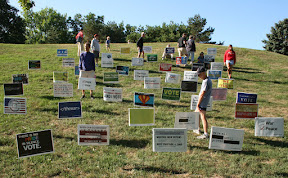
About a month ago, the Walker Art Center sent me an email asking if the neighborhood (I'm chair of the neighborhood organization) would participate in the "My Yard Our Message" project. The what??? It turns out the project is a bunch of artist designed "nonpartisan" lawn signs. The neighborhood got 50 different signs to distribute--kind of a distributed art exhibit in the nieghbohood for the RNC happening across the river. This is part of The Unconvention

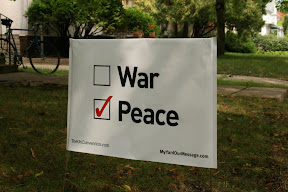
All of the signs are "interesting," some are very good lawn signs
From My Yard Our Message
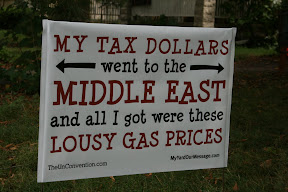
Some are less nonpartisan than others.
From My Yard Our Message

From My Yard Our Message

However, some of the artists did not understand the basic rule for a lawn sign: It has get its message across to someone driving a car at 30 mph.
From My Yard Our Message
If you are in the Twin Cities, check out the Google map of the sign locations. You can buy your own sign at http://www.myyardourmessage.com/signs/winning/